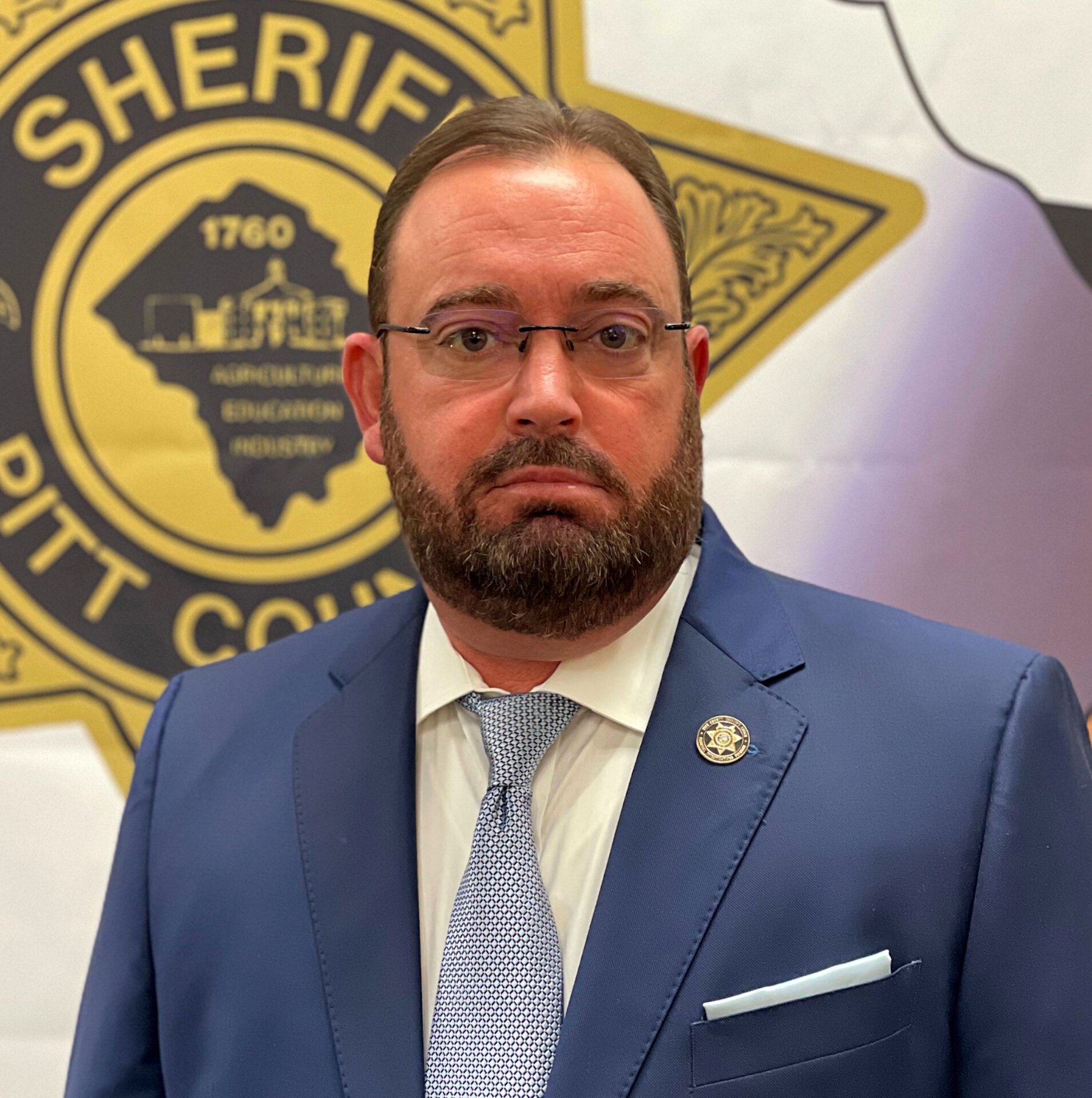
Chief Deputy John E. Guard, IV
Three decades with the Pitt County Sheriff's Office in Greenville, North Carolina — line-level response, investigations, supervision, and agency management. For thirty years, the work has centered on one thing: investigating domestic violence cases and improving the systems that respond to them.
2021
U.S. Department of Justice
Recipient of the Award for First Responders from the National Crime Victims' Service Awards — presented by the U.S. DOJ Office for Victims of Crime.
After the 2004 Crawford v. Washington Supreme Court decision reformulated the standard for admitting hearsay statements in criminal cases, Chief Guard reshaped the investigative practices of the Pitt County Sheriff's Office Domestic Violence Prevention Unit. The unit adopted electronic monitoring for offenders, sharpened its focus on witness intimidation in intimate partner violence, and integrated the Lethality Assessment Program into every domestic violence call.
Legislators and victim advocates have consulted Chief Guard in the drafting of North Carolina state law — including House Bill 1354, which granted powers of arrest for violation of pretrial release, mandated law enforcement training, and elevated strangulation to a felony; and Senate Bill 919, which strengthened firearm removal provisions for offenders subject to domestic violence protection orders.
Programs he has developed have been replicated by agencies across the country — including the Johnson County (Iowa) Sheriff's Office's adoption of his pre-trial electronic monitoring program for domestic violence and sexual assault offenders.
Throughout his career, Chief Guard has trained law enforcement officers and allied professionals on the dynamics of domestic violence from both a law enforcement and social justice perspective. He has worked directly with victims as an officer and a victim advocate, and remains a regular resource for the community on domestic violence prevention.
A career built on improving the response.
1992–1996
Ayden Police Department
Began career as a Patrol Officer (1992), served as Community Policing Coordinator (1994–95), and promoted to Sergeant, Uniform Patrol (1995–96).
1996
Deputy Sheriff, Patrol
Joined the Pitt County Sheriff's Office as a Deputy Sheriff in the Patrol Division.
1997–2008
DV Prevention Unit — Sergeant to Master Sergeant
Rose through the Domestic Violence Prevention Unit: Sergeant (1997), Lieutenant (1998), and Master Sergeant (1999–2008) — supervising DV investigations, protocols, and personnel.
2004
Post-Crawford Reform
Following Crawford v. Washington, restructured the Domestic Violence Prevention Unit's investigative practices — adding electronic monitoring, witness-intimidation focus, and the Lethality Assessment Program at every DV call.
2008–2010
Division Chief, Community Operations
Led the Community Operations Division and served as SRT/CNT Commander — overseeing courthouse security, the Communications Center, and multiple state and federal grants.
2000–2019
Crisis Negotiation Team, Sergeant
Nineteen years on the Pitt County Sheriff's Office Crisis Negotiation Team.
2010–2013
Major Crimes Detective
Investigated major crimes with a special focus on offenses involving intimate partners — evidence, arrests, and prosecution support.
2013–2018
Detective Sergeant, Major Crimes
Supervised the Major Crimes Unit — assigning and monitoring investigations, with continued focus on intimate partner crimes.
Ongoing
Legislative Consultation
Consulted with North Carolina legislators on House Bill 1354 (powers of arrest for pretrial release violations, mandated LE training, felony strangulation) and Senate Bill 919 (firearm removal under DV protection orders).
2021
Award for First Responders
Recipient of the National Crime Victims' Service Award for First Responders, presented by the U.S. Department of Justice's Office for Victims of Crime.
2018–present
Chief Deputy
Serves as Chief Deputy of the Pitt County Sheriff's Office — managing division personnel, policy, budgets, and state and federal grant initiatives — while leading Guard & Associates.
Formal training, continually renewed.
2005
Law Enforcement Executive Program
UNC-Chapel Hill, Institute of Government.
2009
Public Employment Law
UNC-Chapel Hill, Institute of Government.
1992–present
3,000+ hours of law enforcement training
Continuing professional education across investigations, supervision, and IPV response.
Programs designed, launched, and replicated.
2004
Pitt County DV Courtroom Technology Project
Program lead for design and implementation — a grant partnership with the North Carolina Governor's Crime Commission.
2006
NC Electronic Monitoring of DV Offenders
Program lead for design and implementation of the statewide model — a grant partnership with the NC Governor's Crime Commission. Later replicated by agencies including the Johnson County (IA) Sheriff's Office.
2009
DV Witness Intimidation Program
Instrumental in the design and implementation of this grant partnership with the North Carolina Crime Commission.
2013-2019
DV Homicide Prevention Demonstration Initiative
Program lead for Pitt County's participation in the national research initiative — implementing the Lethality Assessment Program (LAP) to prevent IPV homicides.
Service beyond the agency.
Chair
Pitt County Domestic Violence Fatality Review Team
Instrumental in the team's creation.
Chair, Law Enforcement Response Policy Committee
North Carolina Domestic Violence Commission
Advisory Group
Chief Deputies' Leadership Institute, NC Sheriffs' Association
Member
North Carolina Domestic Violence Advisory Committee (Administrative Office of the Courts)
Member
NC Legislative Research Commission — Domestic Violence Committee
Member
North Carolina Child Fatality Task Force
Executive Committee & Governance Board
NC LInX (Law Enforcement Information Exchange)
Immediate Past President
Center for Family Violence Prevention
Past President
North Carolina Victim Assistance Network
Board Member
Real Crisis Center
Management Team
Pitt County Family Visitation Center
Awards, national recognition, and feedback from those who have attended his trainings.
View Full Awards & Recognition →Research, protocols, and policy his work has shaped.
A selection of federal, state, and practitioner publications referenced in — or informed by — Chief Guard's field practice and training.
National Institute of Justice
New Approaches to Policing High-Risk Intimate Partner Victims and Those Who Commit These Crimes
NIJ feature examining evidence-based practices for policing high-risk IPV cases — approaches Chief Guard has helped pioneer and teach.
Read source →U.S. Department of Justice • Office of Justice Programs
National Institute of Justice Journal — Issue No. 282
NIJ Journal issue covering IPV response research and practice relevant to Chief Guard's field.
Read source →Police Executive Research Forum (PERF)
Identifying and Preventing Gender Bias in Law Enforcement Response to Sexual Assault and Domestic Violence
National guide for agencies on eliminating gender bias in IPV and sexual assault response.
Read source →Civic Research Institute
Journal of Offender Monitoring — Vol. 25 No. 1
Peer-reviewed issue covering electronic monitoring of offenders — including pretrial GPS programs of the kind Chief Guard implemented in Pitt County.
Read source →Civic Research Institute
GPS Monitoring — Frequently Asked Questions
Practitioner reference on GPS monitoring for domestic violence and sexual assault offenders.
Read source →NC Department of Administration • Council for Women
Magistrate Protocol for Domestic Violence Cases (2005)
Statewide protocol guiding magistrate response to domestic violence cases in North Carolina.
Read source →North Carolina General Assembly
Domestic Violence Legislative Study (2006)
NC legislative study informing the reforms Chief Guard consulted on — including HB 1354 and SB 919.
Read source →EducationNC archive
Safe at Home: Fighting Family Violence in North Carolina (2005)
Landmark NC report on family violence policy and practice.
Read source →West Virginia Judiciary
Supreme Court of Appeals of West Virginia — 2009 Annual Report
State judiciary annual report referencing domestic violence response training and practice.
Read source →
Bring this experience to your team.
Training, expert testimony, and consulting engagements are available nationwide.